If this question has been sitting in the back of your mind at 1am, you’re not alone. Almost every Dallas bride wonders about it and almost no one asks out loud. So, let’s talk about it plainly, including exactly how the process works with us when ordering your wedding dress.
First: it’s completely normal, and it’s not a problem
Bodies change. Between the day you order your dress and your wedding day, there might be months of stress, travel, new workout routines, medication changes, illness, or just life happening. None of that means you’ve done anything wrong, and none of it means your dress is ruined.
How your dress is actually built
Here’s exactly what happens on our end. The day you order, we measure your bust, waist, and hips ourselves not a guess, not a size sticker, an actual measurement. We then compare those numbers against that specific designer’s size chart (every designer runs slightly differently) and order the size that corresponds to your largest single measurement of the three.
That last part matters: we intentionally order as close to your true size as the designer’s chart allows. We will never order a size up “just to be safe” that’s not how we operate, and it’s not fair to you. Ordering a size larger than you need just adds to your alterations bill later, since a seamstress then has to take in far more fabric than necessary. Our goal is the opposite: order accurately now, so alterations later are as minimal, and as affordable as possible.
That said, it’s ultimately your decision. If you’d specifically like us to order a size up as a cushion against an expected change, we’re glad to do that we’ll just talk it through with you and give you our honest recommendation first.
Every dress we order also comes with a built-in 1–2 inch seam allowance on the inside, specifically so a seamstress has room to let it out later if needed. That allowance exists precisely for situations like this it’s not something you have to ask for, it’s already part of how the designer constructs the gown.
Our process: we connect you, we don’t alter
Here’s the part that’s important to be upfront about: we don’t perform alterations in-house. What we do instead is give every bride a list of alterations professionals that past brides have used and recommended. It’s a genuinely useful head start you’re not searching blind, but a few things follow from that setup, and we want you to walk in with clear eyes:
- Each seamstress or tailor on the list runs their own independent business, with their own calendar, pricing, and booking process. We don’t manage their schedules or guarantee availability.
- It’s on you to reach out early and confirm timing. Popular alterations providers, especially during busy wedding season can book up weeks or months in advance. The sooner you contact someone from the list, the more likely their schedule will line up with yours.
- Compare a few options if you can. Because each provider is different, it’s worth a quick call or message to two or three names on the list to compare availability, pricing, and how many fittings they typically recommend, before you commit to one.
- Once you’ve reached out, they’ll set your fitting schedule based on your wedding date which is where the weight-change question actually gets resolved.
Why the timing works in your favor
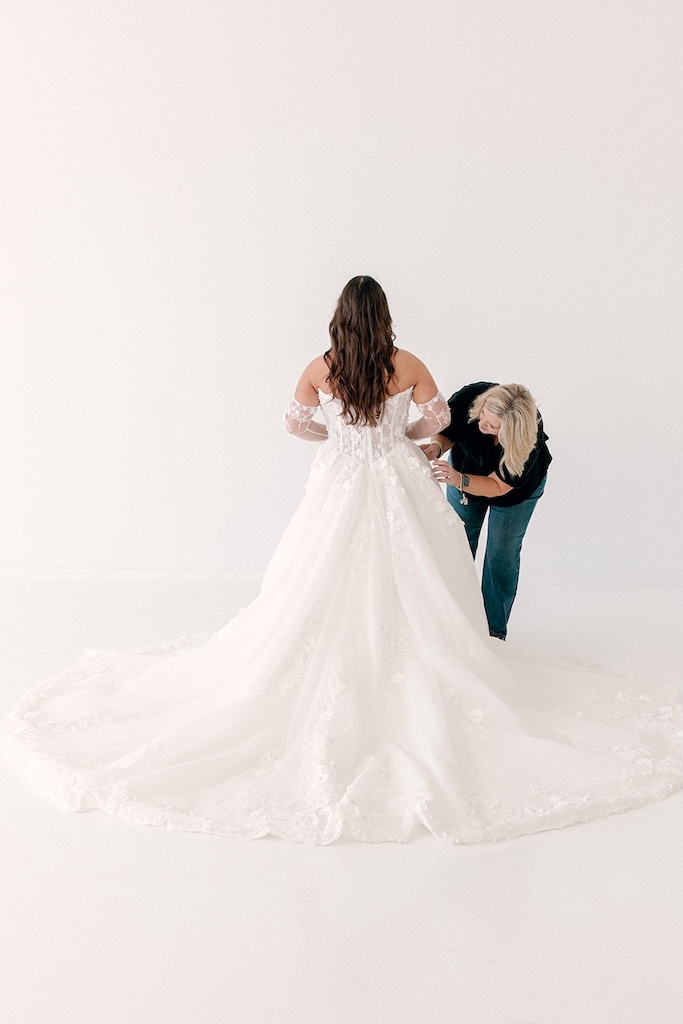
This is the key thing worth understanding: your final measurements aren’t locked in when you place your order. They’re locked in much later, at your first fitting with your alterations provider which means the dress is made with room for change and fitted after most of that change has already happened.
Most bridal experts recommend booking your first fitting somewhere around 8–12 weeks before the wedding, with two to three total fittings from there, spaced a few weeks apart. According to The Knot’s guide to wedding dress alterations, the process typically takes 6 to 8 weeks start to finish, with the final fitting landing close to the wedding date so the fit reflects your body as it actually is, not as it was months earlier. The Knot’s wedding dress shopping timeline is also a helpful resource if you’re still mapping out when to order relative to your date.
If you’re planning a Dallas-Sherman wedding, this timing works the same way no matter which alterations provider from our list you choose, just build in a little extra lead time if your wedding falls during a busy local season, since availability with any given provider can tighten up.
Because of that timing, a change in weight between ordering and your first fitting usually isn’t something to solve on your own, it’s exactly what that first appointment is for.
How much do wedding dress alterations cost?
This is usually the second question right behind the weight-change worry, so it’s worth answering directly. Nationally, standard alterations like hem, bustle, and a bodice or waist adjustment typically run $300 to $800, with a full package of more involved work landing closer to $700 to $1,000. Heavily beaded, structured, or multi-layer gowns can run higher. A common rule of thumb is to budget roughly 10–20% of your dress’s purchase price for alterations.
Where you have your dress altered matters too, pricing varies by market and by individual provider. This is exactly why we hand you a list rather than a single name: it lets you compare pricing and find someone whose rates and availability fit your budget and your Dallas/North Texas -area timeline, rather than being locked into one option.
What to do if you notice a change
- Reach out to your chosen alterations provider as soon as you notice it, rather than waiting for your scheduled fitting. Earlier notice gives them more room to plan.
- Don’t panic-diet or panic-eat to “fix” it before your fitting. Sudden last-minute changes create more unpredictability for the person adjusting your dress, not less.
- Be honest about your timeline when you book. If your wedding is coming up quickly, or if you expect your body to keep changing, say so, your alterations provider can plan the number and spacing of fittings around that.
- Bring your actual wedding-day shoes and undergarments to every fitting. A surprising amount of fit and comfort feedback comes from these, not from your body changing.
- If a change turns out to be more than a standard seam allowance can absorb, your alterations provider will tell you plainly what’s possible, added fabric panels, a different closure, or occasionally a resize. This is uncommon, and it’s a solvable problem, not a crisis.
The bottom line
Your dress is built with intentional flexibility, and the fitting process exists specifically because bodies can change between ordering and the wedding day. Our job is to hand you a trusted list of people who do this well; from there, the timeline is really a conversation between you and whichever alterations provider you choose. The one thing that actually matters is not staying quiet about it — reach out early, be upfront about your date, and let a professional who does this every day tell you what your options are.
A few pounds either way, in either direction, is exactly what alterations exist for and it’s exactly why Dallas brides come to us not just for the dress, but for a process that plans for real life from day one.
Let us help you navigate the wedding dress shopping without pressure and provide our advice along the journey. Book your appointment today at asherlanebridal.com